

If you're the CFO of a growing e-commerce brand, ABL usually shows up at a very specific moment.
Revenue looks good. Demand is real. But cash is tight. Inventory orders are getting bigger. Wholesale receivables are stretching. Money leaves early and comes back late. Then the question lands on your desk: should we put an asset-based lending facility in place?
I think ABL can be a very useful tool. I also think it gets oversimplified.
Before I built Paperstack, I spent years in banking. I kept seeing the same systemic lending gaps. Strong consumer brands were being declined because traditional underwriting was built for factories, equipment, and hard collateral. It was not specifically built for CPG brands or modern e-commerce.
That disconnect is why CFOs need to understand ABL at a structural level. The headline credit limit is the easy part. The real question is simpler and much more important: does the structure fit the way cash actually moves through your business?
Why ABL Keeps Coming Up
ABL is not some niche side conversation anymore. Total available ABL lines grew 10.3% year over year in 2022. Secured Finance Network data also shows bank ABL outstandings rose 25.5% and non-bank outstandings rose 19.4% in the same year.
That growth makes sense. Around 60% of companies say longer payment terms push them toward alternative working-capital financing. About 24% of businesses say they do not have enough cash to fund even one year of operations. High rates are adding even more pressure. Roughly 54% of firms cited high interest rates as the biggest obstacle to new capital.
I see the pressure most clearly around the $5 million revenue mark. Many brands at that stage are too large for personal credit products, but still do not fit neatly into traditional commercial lending boxes. They may need a $500,000 to $1 million working capital facility. Instead, they get pushed toward personal lines of credit or a patchwork of platform-specific products. That is exactly why ABL enters the conversation.
What ABL Actually Means
The Borrowing Base Is the Core of the Deal
Here is the simple version. ABL is a line of credit secured by business assets. In commerce, that usually means inventory and accounts receivable. Sometimes in-transit inventory can count too, but usually at a lower advance rate.
The lender builds a borrowing base. That means they decide what is eligible, what is excluded, and what percentage they will lend against it. Terms are the keys.
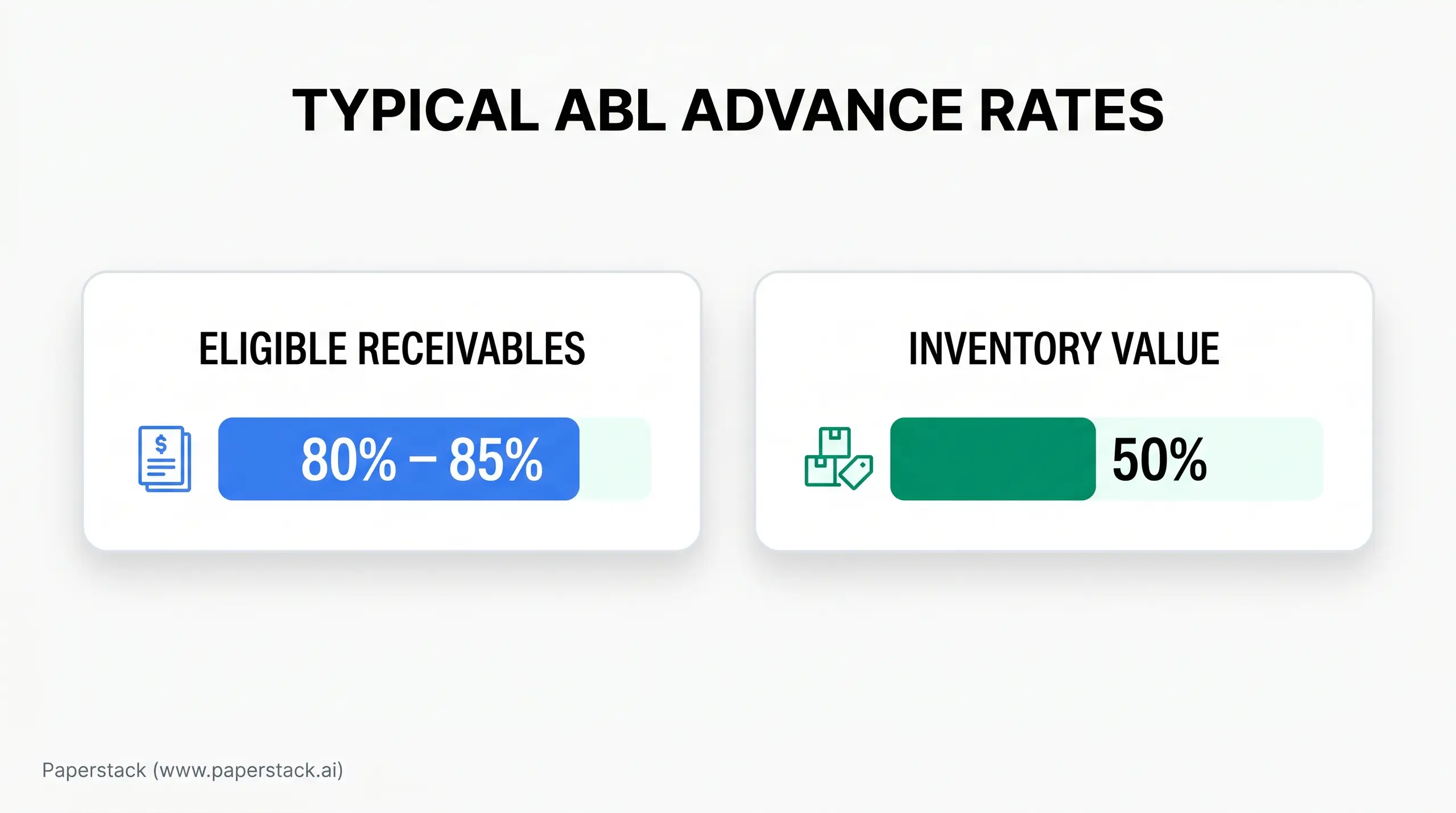
Advance rates vary a lot. One industry overview puts eligible receivables around 80% to 85% and inventory closer to 50% of value. In my own conversations with lenders, founders often hear broad numbers early, then discover the real availability is lower once eligibility rules are applied and in-transit inventory is haircut further.
So if you have $1 million of eligible receivables and the lender advances 80%, that can create $800,000 of availability. If a large chunk of inventory is still on the water, the math changes. That is why the approved facility size and the usable line are not the same thing.
The Line Is Not the Same as the Draw
This is the next mistake I see all the time. A company gets approved for a large line and feels tempted to take all the money upfront just to feel safe.
I compare that instinct to maxing out a credit card because the limit is there. The moment you draw, you start paying for the capital. So before you take the full amount, ask one very plain question: what do you do with the cash, and if you do nothing, how much does it cost your business to keep it in the bank account?
I once helped an apparel brand that had become unprofitable during slow seasons because it was remitting close to 25% of daily sales to service a lump-sum loan that had not been used efficiently. We restructured the capital into 60-day tranches and stretched the balance over a longer payback period so the remittance would not be as severe. The lesson was simple. If you are not using that capital in the next 30 to 45 days, you should not be taking that capital upfront.
Where ABL Fits Best

Wholesale, Retail, and B2B-Heavy Brands Usually Have the Cleanest Fit
In my experience, ABL works best when the business naturally creates financeable assets. That usually means wholesale, retail, and B2B-heavy brands.
Why? Because the lender is not only looking at inventory. They are also looking at receivables. That gives the facility more room to bridge the AR and the AP in a way that can lower pressure on the business.
The market data reflects that. In that same survey, retail-sector ABL lines grew the fastest, while wholesale remained the largest sector by total volume. I am not surprised by that at all. Those channels produce the kind of collateral ABL was designed to underwrite.
Receivables Change the Story
I also like B2B channels because they improve structural stability. I have seen a brand sell products in bulk to banks and law firms for corporate gifting. Those larger orders created receivables that strengthened the capital story. They also acted as "free advertising," because the gift recipients later converted into direct customers.
There is another lever here. If a brand offers personalization, like adding a corporate logo, it can often justify asking for an upfront security deposit. That improves the cash cycle before the ABL line even enters the picture. For a CFO, that matters. Every improvement in timing protects margin and lowers dependency on expensive capital.
Where ABL Can Quietly Hurt a Scaling Brand
Inventory-on-Hand Covenants Can Become a Real Problem

This is the part many teams underestimate. ABL can work well, but the covenant package can create friction if it is built around old assumptions.
The biggest example is the inventory-on-hand covenant. I understand why lenders want it. They want collateral sitting on the balance sheet. But for a scaling e-commerce brand, especially a seasonal one, holding extra inventory can be expensive and unhealthy.
By keeping it in a warehouse, a bank may view it as comfort. The brand may just see storage costs, markdown risk, and aging product that should have moved already. I have seen traditional bank covenants require inventory on hand and minimum cash balances at the exact moment the brand needed to move through a seasonal collection quickly. That kind of structure works against the business.
If I were negotiating that covenant, I would bring historical data. Show the lender your lowest inventory levels, your peak inventory levels, and the natural swings in between. Tell the story and back it with historical performance. A static minimum rarely reflects how a healthy seasonal brand actually operates.
Strong Sell-Through Can Shrink Your Borrowing Base
There is a second structural issue that matters even more.
As a brand sells through inventory, the borrowing base can fall. So the facility gets tighter while demand is doing its job. For seasonal businesses, this can be a real flaw in the structure. You still need working capital to cover fixed costs and place the next order, but the collateral base is shrinking because the product is finally moving.
That is one reason I keep saying growth isn't just about how much you sell, it's about when you sell it.
I have seen versions of this pressure in highly seasonal businesses. A roughly $10 million snack brand, for example, faced a summer cash crunch even though the broader business was healthy. Timing changed the capital answer. I am ultimately not a huge fan of betting 70% or 80% of annual revenue inside one short period and hoping the financing structure will keep up.
Stockouts Are Expensive in Ways Many Teams Miss
I am very direct on this point. Selling out is a financial failure or operational failure unless it was a planned limited-edition drop.
Retailers globally lose $984 billion a year in potential sales because of out-of-stocks. Shoppers run into an out-of-stock item on roughly one in three shopping trips. The cost is much bigger than one missed transaction.
I have seen a roughly $5 million wellness brand go viral and sell out on Amazon. The outside view looked exciting. The real result was painful. The brand lost search ranking and had to work twice as hard to get visibility back.
I have also seen an approximately $10 million wellness brand deplete inventory faster than planned because the marketing agency was so efficient. The company had to pause expansion into new channels just to preserve enough stock for its core DTC customers.
From the outside, it might look like a celebration, but from the inside, it's a massive pressure internally operationally for the team. Finance starts scrambling for emergency capital. Operations may need smaller production runs or expensive air shipping. Marketing has to stop campaigns that were working and then spend again later to rebuild the relationship with the customer. Under ABL, the pain can deepen because lower inventory can also reduce borrowing availability.
How I Would Pressure-Test an ABL Facility
Start with Timing Before You Start with Rate

When I review any facility, I begin with timing.
When does the supplier deposit go out? When is the final payment due? How long is production? How long is transit? When do wholesale receivables actually land? When does Amazon release cash? Break up that movement into numbers.
If the real gap sits before goods become eligible collateral, ABL only solves part of the problem. You may still need a structure that lets you draw in stages. I prefer aligning capital draws with physical supply chain milestones. Take one draw for the manufacturing deposit. Take the next one for the final payment when goods ship. Wait to draw marketing capital until the goods actually arrive. Otherwise you carry the cost of capital while the money sits idle.
Then Run the Downside Cases
For me, unapologetic optimism isn't about blind positivity - it's about discipline.
One brand partner was hit with sudden import tariffs that raised landed costs almost overnight. Instead of freezing inventory orders and cutting everything immediately, we ran multiple scenarios. We looked at what happened if tariffs held, dropped, or expanded. We reviewed unit economics, pricing flexibility, customer retention, and whether some of the cost could be split with suppliers.
That work gave the team options. When the market stabilized, they were one of the few brands still fully stocked and they captured meaningful market share while competitors were still hesitating.
I have also seen strong supplier relationships matter a lot in these moments. If you have been in good standing, sometimes you can divide unexpected costs with the vendor. Building social capital with suppliers is not some soft idea. It becomes very practical when volatility hits.
Prove the Operating Engine, Not Just the Collateral

Traditional lenders often look at marketing spend as a pure expense. In e-commerce, that view misses a huge part of the business.
Many growing brands put 15% to 25% of annual revenue into marketing. For the right brand, that is an investment engine. The CFO's job is to prove whether that engine is healthy and repeatable.
This takes real math. What percentage of revenue goes to advertising? How much revenue does every dollar produce? Is the business profitable on the first order, or does the model rely on LTV from the second or third order? What happens if you reduce spend?
That was exactly the problem with the beverage brand I saw in banking. The lender saw expense. I saw cash flow quality. For me, cash flow quality means predictability, timing, and sustainability. That is the real measure of resilience in commerce.
Questions I Would Ask Before Signing
I would ask very plain questions. What counts as eligible inventory? What gets excluded? How much are you advancing on receivables, on-hand inventory, and in-transit goods? What happens in my lowest inventory month? If my business is seasonal, can the covenant move with my historical ranges instead of forcing one flat threshold all year?
Then I would ask about control. Does the lender send funds to my bank account or pay suppliers directly? Are there origination, admin, or wire fees hiding behind the headline pricing? Are personal guarantees required? Who owns the relationship after close? You should not have to re-explain your business every time something changes.
I would also look closely at the rest of the capital stack. If you already have one provider for Amazon, another for Shopify, and something separate for wholesale, project how each one affects cash flow. A slowdown in one channel can spook one lender, put additional stress on the business, and create a domino effect across the rest of the stack. One provider can be a cleaner answer, but only if that lender understands the whole business.
When I Would Choose a Different Structure
ABL is one tool. It is usually a stronger fit for wholesale and retail-heavy brands with real receivables and enough eligible inventory to support the line.
If the business is more asset-light, more DTC-led, and the real problem is timing between inventory, marketing, and platform payouts, I would also look at cash-flow-based capital.
I also believe the most expensive capital you can use for recurring inventory or predictable marketing is equity. Equity should be reserved for experiments. New products. New channels. Specific hires. International expansion. Once a brand reaches several million in revenue, it usually has enough history to fund repeatable inventory cycles with non-dilutive capital. Most e-commerce brands place those orders two or three times a year. Funding each one with equity creates unnecessary dilution.
Final Thought

My view on ABL is simple. It can be a very good facility for the right brand. It can also create real friction if the structure rewards inventory sitting still, punishes fast sell-through, or ignores the true cash flow engine of the business.
As CFO, your job is to structure capital in a way that grows in rhythm with your brand. Look past the headline line size. Read the mechanics. Push on the covenants. Pressure-test the timing.
Alignment - not just access.
When capital starts working with your business, not against it, planning gets sharper, margins get easier to protect, and growth becomes much more durable.
Frequently Asked Questions
How do rising interest rates impact the cost structure of an ABL facility?
In 2023, 54% of firms called high rates their top capital obstacle. ABL is floating-rate debt, so costs fluctuate. I tell CFOs to stress-test margins against a 200-basis-point hike before signing.
What reporting burden should my finance team expect with a standard ABL?
Reporting is rigorous. Because lenders advance 80% to 85% on eligible receivables, you must provide weekly or daily borrowing base certificates. Ensure your ERP automates this, or manual friction will burn your team out.
Can we use ABL to finance our international expansion and foreign receivables?
Usually, no. Domestic lenders routinely exclude foreign accounts receivable and overseas inventory from the eligible borrowing base due to cross-border collection risks. I am very direct on this: fund international expansion with equity, not debt.
How do asset-based lenders monitor collateral health post-close?
Expect mandatory field exams. The lender will send auditors periodically to physically verify inventory and test your receivable collections. For a CFO, that matters. If your inventory tracking is sloppy, these exams will trigger availability blocks.
Will ABL covenants restrict our ability to make strategic acquisitions?
Yes, almost always. ABL agreements contain strict negative covenants that limit capital expenditures, new debt, and M&A activity without lender consent. If you plan to acquire competitors, you must negotiate flexible carve-outs before finalizing the credit agreement.